In the world of commercial design, a common frustration persists: a space that looks stunning but fails the moment it becomes occupied. We have all experienced the "echo chamber" conference room or the "private" office where you can hear every word from the adjacent suite. Usually, these failures aren’t due to a lack of acoustic treatment, but rather a misunderstanding of acoustic rating systems and how they apply to real-world assemblies.
For architects and designers, picking a product based on the highest headline number is logical. However, NRC, CAC, and STC are not interchangeable metrics. They measure entirely different physical pathways of sound. To design a high-performing interior, you must first identify the acoustic symptom you are trying to cure.
NRC, CAC, and STC Do Not Measure the Same Thing
One of the most frequent specification mistakes is assuming that a high NRC (Noise Reduction Coefficient) will provide speech privacy. It plays an important part, but isn’t the entire solution. While NRC deals with the "liveliness" of a room, STC and CAC deal with the "leakage" between rooms.
Rating | What it Measures | Primary Goal | Where it Lives |
NRC | Sound Absorption | Reduce echo / reverberation | PET/acoustic surface materials (Panels, Baffles) |
CAC | Sound Attenuation of Ceiling | Block sound through ceiling plenum | Acoustic ceiling systems/Tiles |
STC | Sound Transmission | Block sound through walls / floors | Wall assemblies, Doors, Glass |
How to Interpret NRC in Practice
The NRC acoustic rating is an average of a material's sound absorption coefficients at four key frequencies: 250, 500, 1000, and 2000 Hz. It is a value between 0 (total reflection) and 1.0 or higher (total absorption).
In high-traffic zones like open-plan offices, hospitality venues, and education spaces, NRC is your primary tool. It prevents sound from bouncing off hard reflective surfaces, such as gypsum board or glass, which reduces sound pressure levels and improves speech clarity.
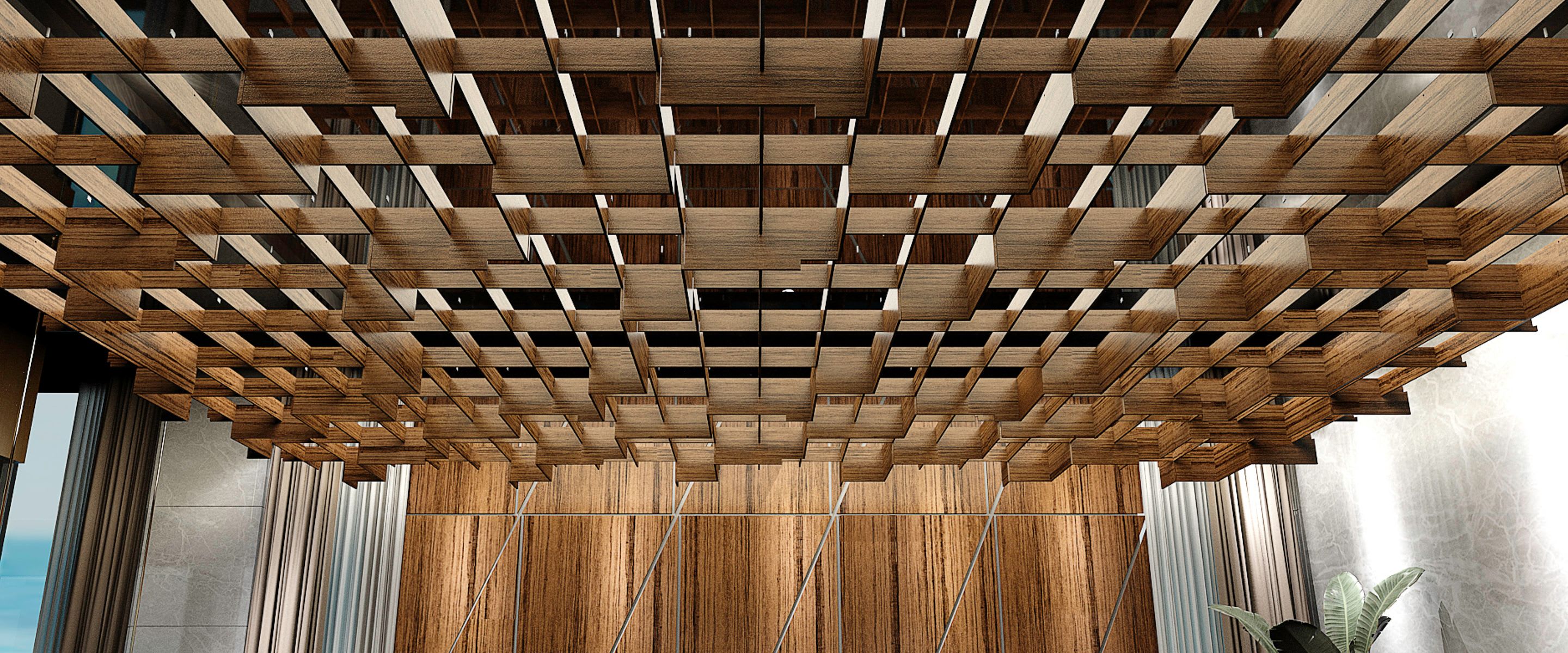
Technical Nuance: You may see Zintra products with an NRC exceeding 1.00. This is not "marketing math" - it is a result of ASTM C423 lab testing. When three-dimensional objects like acoustic ceiling beams or acoustic baffles are tested, their increased surface area and edge effects can absorb more sound than their two-dimensional footprint, resulting in a rating above 1.0. (Note that the absorption coefficients are a coefficient, used to calculate sound absorption in Sabins when multiplied by area covered, not a percentage).

How to Interpret CAC in Practice
CAC (Ceiling Attenuation Class) is the missing link in many privacy failures. It measures a ceiling system's ability to act as a barrier to airborne sound travelling through a shared plenum. The number rating reflects how many decibels the sound level is reduced by through the ceiling plenum.
In many modern fit-outs, interior walls stop at the ceiling grid rather than extending to the structural deck. This creates a "flanking path" where sound travels up through the ceiling of Room A, over the wall, and down through the ceiling of Room B.
CAC < 25: Minimal privacy; conversations are easily understood next door.
CAC 35+: High performance; essential for healthcare consult rooms or private HR offices.
When comparing CAC vs NRC, remember: NRC makes the room comfortable for the person inside it; CAC keeps the conversation from the people outside it.
How to Interpret STC in Practice
STC (Sound Transmission Class) measures the transmission loss of an entire assembly - not just a single material. It defines how much sound, in decibel reduction, a wall, floor, ceiling, window, or door blocks.
For a boardroom or a multi-family dwelling, a high STC rating (typically 50+) is the gold standard for sound isolation. However, STC is only as strong as its weakest link. A high-STC wall becomes irrelevant if there is an unsealed gap under a door or a shared HVAC duct acting as a path for sound to easily travel.
When weighing NRC vs STC, realize that you often need both. A boardroom with high STC walls but no NRC treatment will be private, but the "boomy" echo inside will make a speakerphone call nearly impossible to understand.


Which Rating Should Lead by Space Type?
1. Open-Plan Offices
Priority: NRC. The goal here is to reduce the "cocktail party effect." Use acoustic ceiling clouds and acoustic panels to target a reverberation time (RT60) of less than 1.0 second.
2. Private Offices & Meeting Rooms
Priority: STC + CAC. Speech privacy is the legal or professional requirement here. Ensure your wall assembly has a sufficient STC, and if your walls don't go to the slab, specify a ceiling with a high CAC.
For clarity of speech within a private office, the target reverberation time (RT60) is less than 0.6 seconds.
3. Healthcare Consultation
Priority: All Three. Confidentiality is non-negotiable (STC/CAC), but acoustical performance within the room (NRC) is required for patient comfort and clear communication between doctor and patient.
Specifier Checklist: Before You Choose
Before prioritizing a rating, ask:
Is the partition wall-to-deck? If no, CAC is just as important as STC.
Is the goal comfort or confidentiality? Comfort = NRC. Confidentiality = STC/CAC.
Are we looking at a material or an assembly? You specify a panel for NRC, but you specify a system for STC.
What is the room volume? A high NRC rating on a small surface area may not be enough to fix a large, "boomy" lobby.

Choosing the Right Rating for the Right Outcome
Ultimately, acoustical performance is about the harmony of walls, floors, and ceilings. Whether you are looking for the geometric precision of acoustic tiles or the bold architectural lines of suspended beams, the rating you choose must match the problem you are solving.
Zintra’s design-led solutions are engineered to bridge the gap between technical building code requirements and expressive interior design. By understanding the nuance of NRC, CAC, and STC, you move beyond just "adding panels" - you are engineering an experience.