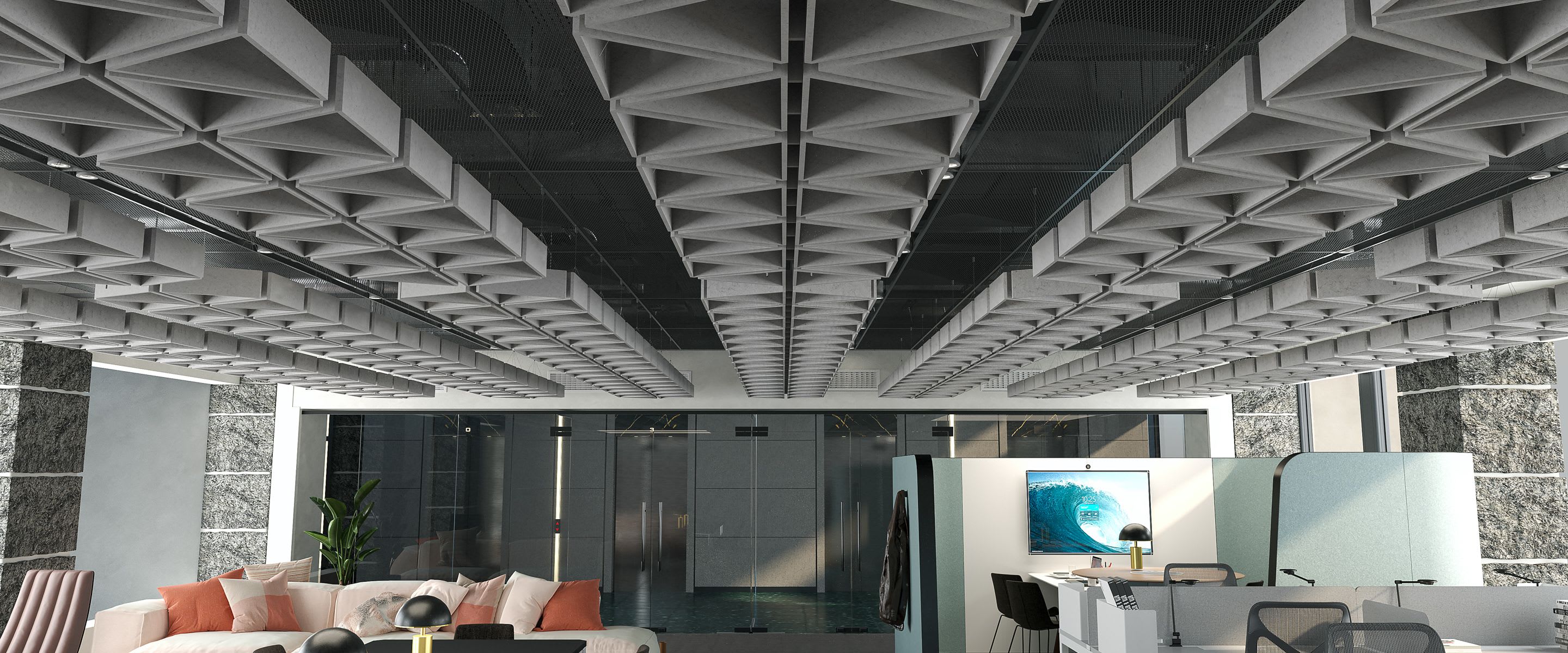
In highly trafficked commercial buildings, hard interior surfaces like concrete, glass, and drywall dominate the aesthetic. While these materials offer crisp architectural lines, they create a severe acoustic side effect: a massive buildup of sound reflections. Uncontrolled reverberation degrades speech clarity, drives up ambient noise control issues, and actively compromises productivity and user comfort.
When addressing these reverberation challenges, the ceiling plane is almost always your most effective tool. It represents the largest unencumbered surface area available for sound absorption. However, simply picking a product with the highest Noise Reduction Coefficient (NRC) does not guarantee success.
The optimal ceiling treatment must reconcile the specific geometry of the space with the overall design intent. Whether you are working with an exposed deck, a tight slab-to-ceiling clearance, or a sprawling open layout, you must choose a suspended sound absorbing system or direct-mount assembly that aligns with those conditions. This is where design-led acoustic systems, such as Zintra ceiling solutions, can help turn acoustic treatment into part of the finished interior rather than an afterthought.
Panels vs Baffles vs Clouds: Quick Comparison
Solution | Best For | Main Acoustic Advantage | Design Impact |
Acoustic ceiling panels | Low to standard ceilings, enclosed meeting spaces | Distributed absorption across the entire ceiling plane | Clean, low-profile, minimalist finish |
Acoustic ceiling baffles | Tall, open plenum environments, large room volume | Two exposed absorptive faces maximize effective surface area | Linear rhythm, structural depth, and overhead movement |
Acoustic ceiling clouds | Exposed ceilings, multi-use zones, and focal points | Localized absorption directly above occupied areas | Floating, sculpted architectural feature and spatial zoning |
Use Acoustic Ceiling Panels for Low-Profile, Distributed Absorption
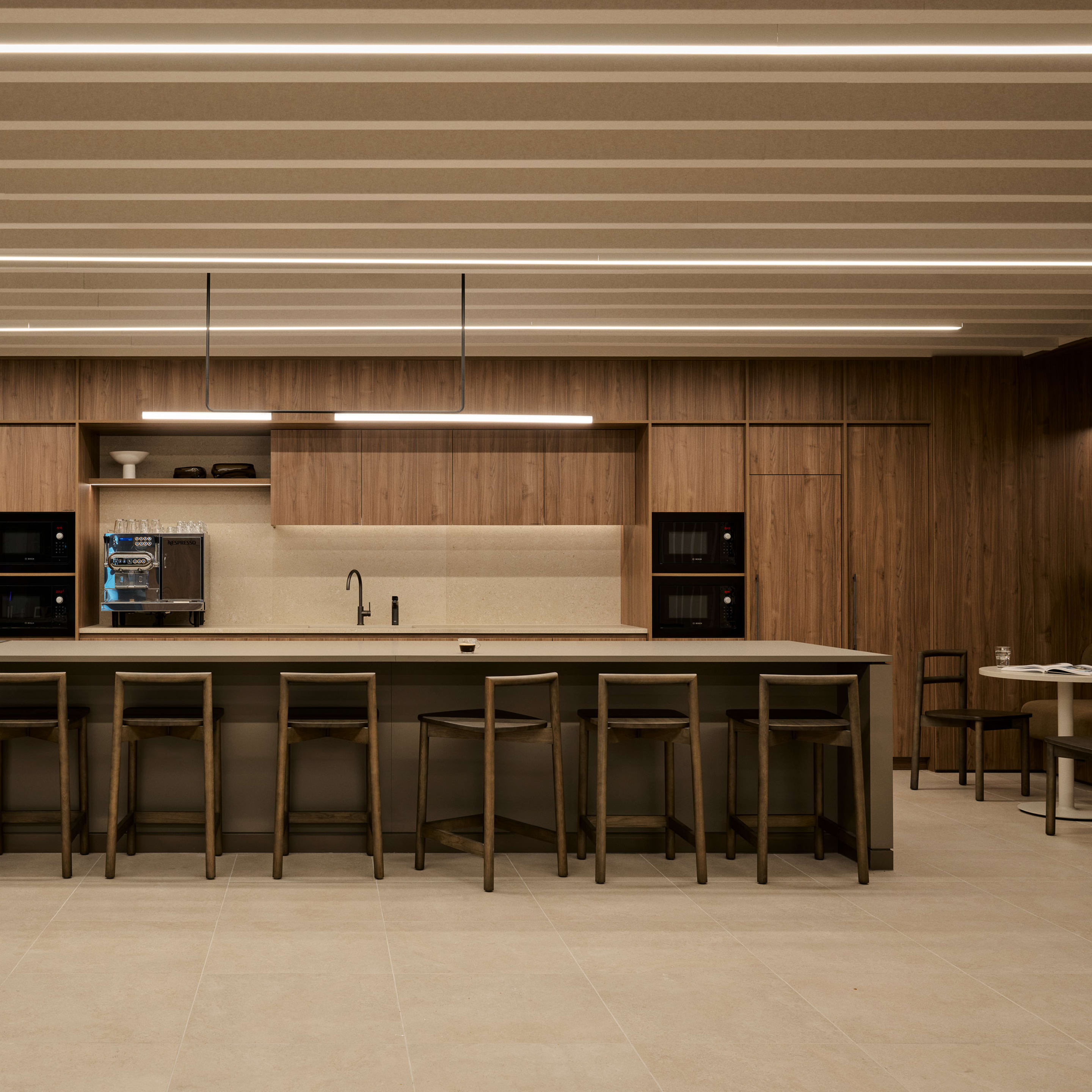
Acoustic ceiling panels are the ideal choice when the design requires broad-scale sound control without altering the architectural profile of the space. This approach is highly effective in environments with standard or restricted ceiling heights where suspended sound absorbing elements would interfere with sightlines, lighting layouts, or mechanical access.
Specifying a direct-mount installation of acoustic panels allows you to establish a clean, unified ceiling plane. This is especially valuable in environments requiring uniform speech intelligibility across a fixed footprint, such as corporate boardrooms, enclosed private offices, or traditional classrooms.
Technical performance in flush-mounted applications relies entirely on distributed overhead absorption. Because the material sits tight to the substrate, it primarily targets high-frequency reflections. Its efficiency depends on total panel thickness, the exact surface area coverage, and the performance of the backing substrate. Available in both 12mm and 24mm thicknesses, Zintra acoustic panels support this low-profile approach, with additional layers able to be added as a backer or sheets laminated together for higher sound absorption, with or without an air gap. Color and layout flexibility allow the ceiling plane to remain clean while contributing to acoustic comfort.

Use Acoustic Baffles for Large-Volume Reverberation Control
When room volumes are large and reflective surfaces dominate the space, a flat panel array is often structurally or financially impractical. For expansive, double-height spaces or environments with an open plenum, acoustic ceiling baffles are the standard specification path.
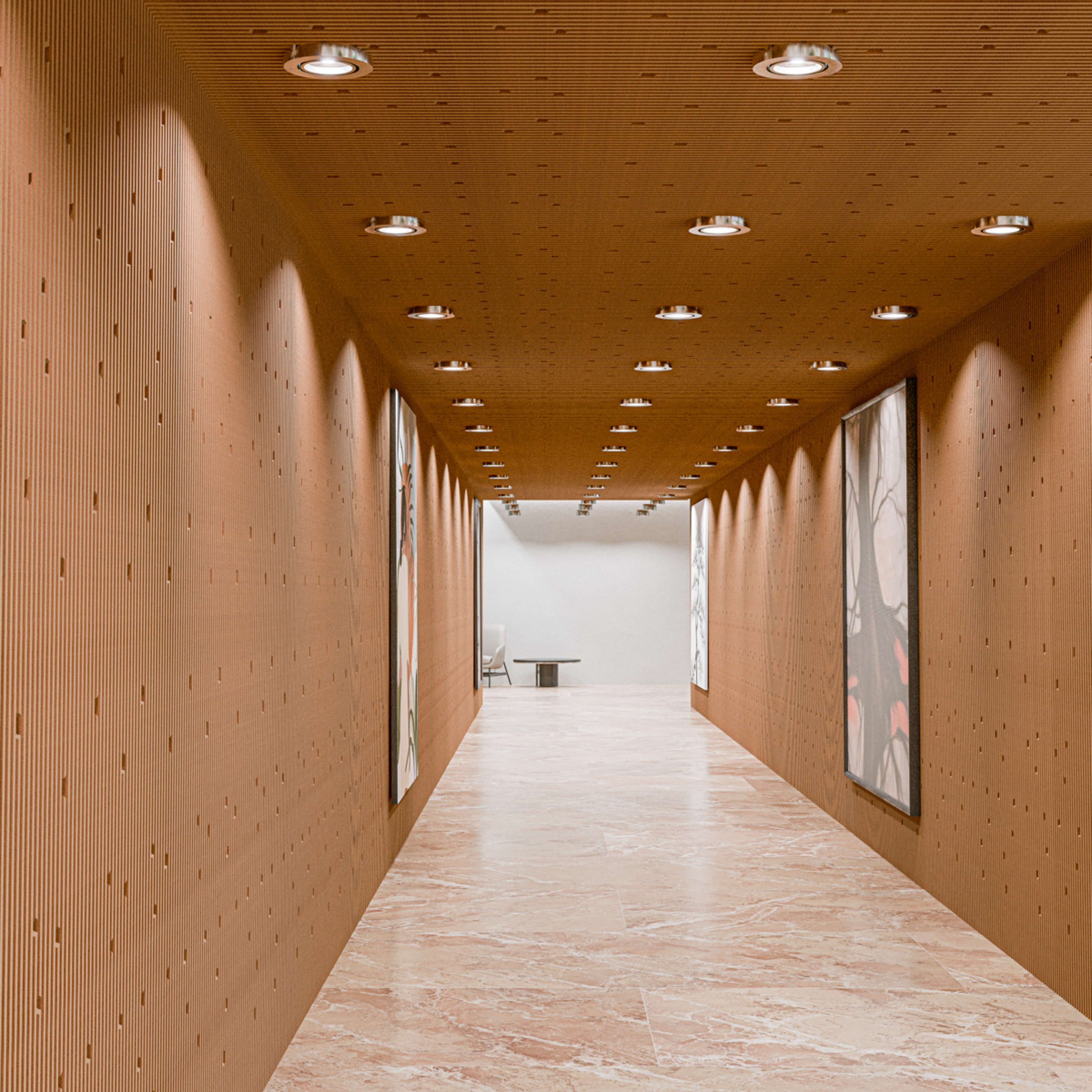
Acoustic baffles are suspended panels that hang from the ceiling in a series of parallel rows. This orientation introduces a distinct technical advantage: it provides effective acoustic absorption while maintaining access to the ceiling plane for lighting, sprinklers, HVAC and other building services.
The acoustic performance of a baffle ceiling system is highly customizable. It is determined by baffle depth, horizontal spacing, total quantity, and suspension height. Adjusting the distance between rows allows you to fine-tune the system to capture lower frequencies or accommodate heavy HVAC ductwork. Visually, Zintra baffles can introduce acoustic absorption while adding linear rhythm, directional emphasis, and visual movement to the overhead plane.
Use Acoustic Clouds for Targeted Absorption and Ceiling Definition
In many modern commercial layouts, the acoustic challenge is not general noise control, but localized distraction. In an open-plan office or a mixed-use hospitality space, you often need to isolate the acoustic energy of a collaborative lounge or dining area from the surrounding quiet workstations.
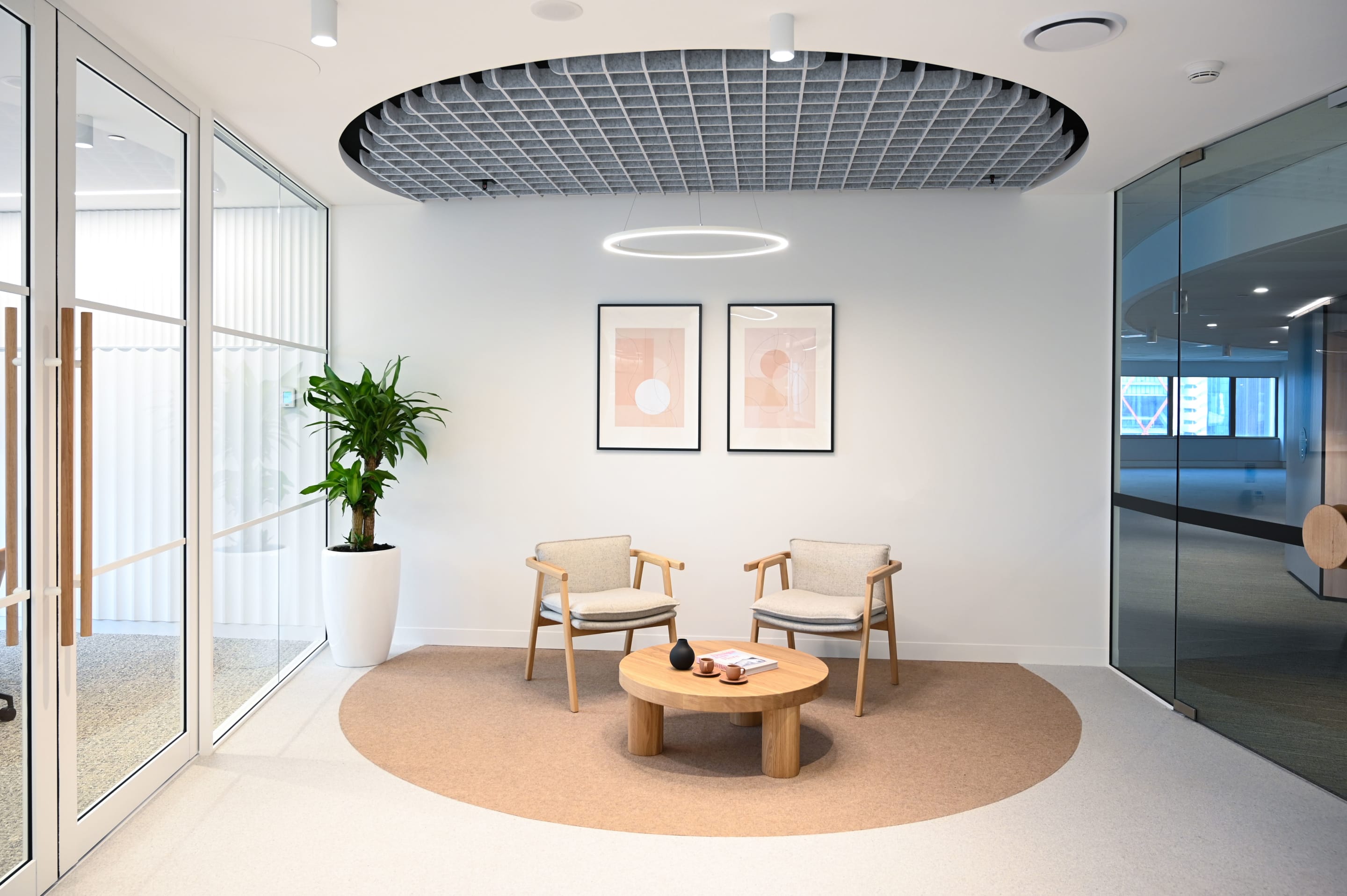
Acoustic ceiling clouds are suspended three-dimensional architectural elements that float below the structural deck. Rather than treating the entire room volume, they deliver targeted sound absorption directly above noise-generating clusters. This allows you to implement effective acoustic zoning without erecting permanent physical walls.
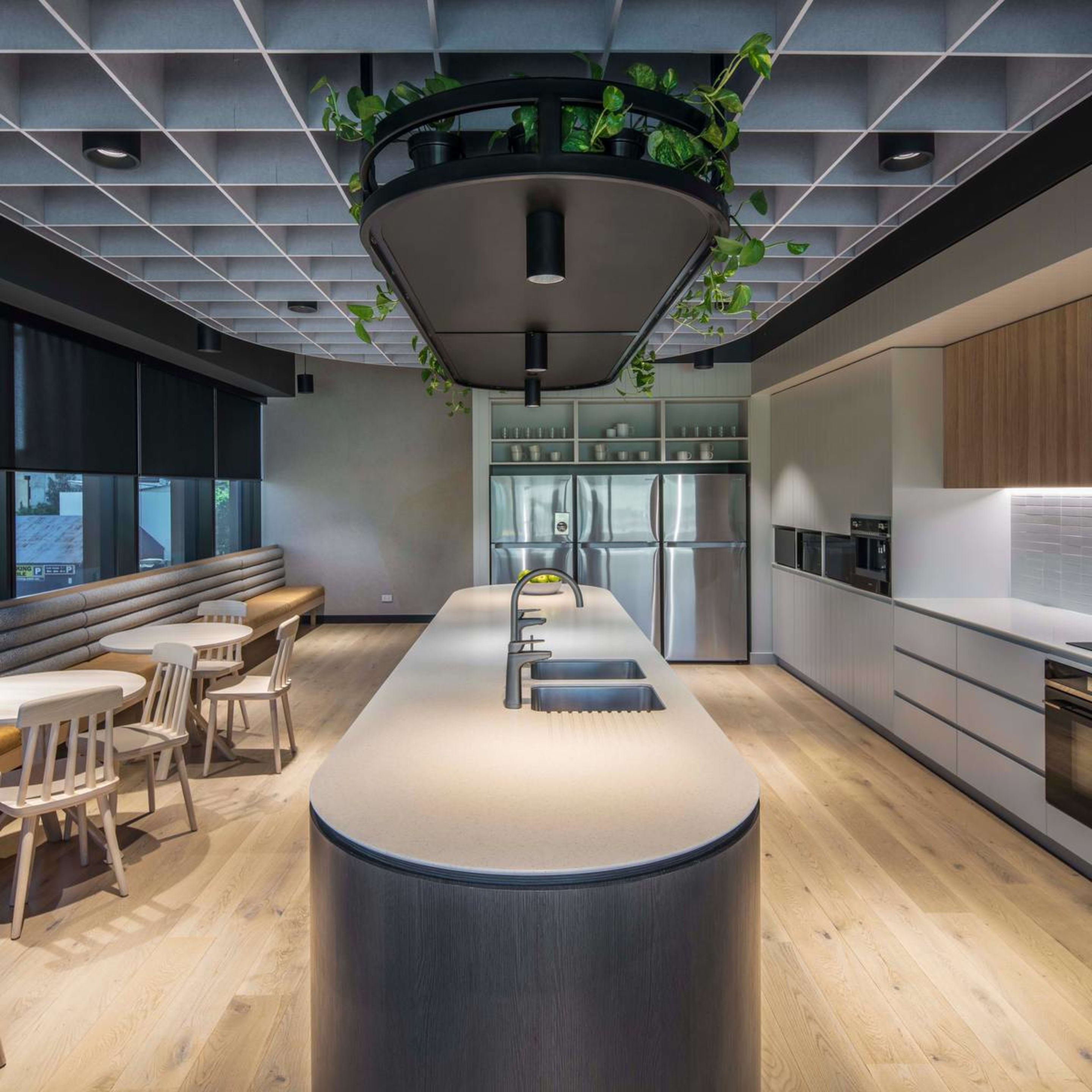
From a performance standpoint, acoustic clouds benefit significantly from the air gap created between the floating panel and the slab above. This cavity traps sound waves that pass through the panel, catching them a second time as they attempt to reflect back down into the room. Zintra acoustic clouds can support this approach by combining overhead absorption with form, color, and layout options that help define zones architecturally.
How NRC Should Influence Specification
The standard metric for comparing acoustic ceiling options is the Noise Reduction Coefficient (NRC). Calculated by averaging sound absorption coefficients at 250, 500, 1,000, and 2,000 Hz, the number serves as a valuable baseline. An NRC of 0.80, for instance, represents the average of the material’s absorption coefficients across these four frequencies.
However, the headline number on a data sheet can be misleading if read away from the context of the installation conditions. A product’s tested rating changes drastically depending on how it is mounted in the field.
Where product data is available, reference the tested Zintra NRC value alongside the installation method, such as direct-mounted, suspended, or air-gap configuration. For example, a direct-fixed Zintra 12mm panel delivers an NRC of 0.45. The exact same material utilized within a suspended or air-gap configuration can achieve up to an NRC of 0.95 at a 12” air gap because the space behind the panel allows it to capture longer, lower-frequency sound waves. The highest NRC is not automatically the right choice; you must match the product thickness and assembly style to the room’s specific reverberation target.
Absorption Is Not Soundproofing
A critical distinction for any specifier to maintain when evaluating building materials is that sound absorption is fundamentally different from sound isolation.
Installing acoustic panels, baffles and clouds will alter the acoustic harshness within a single room. These systems excel at reducing flutter echo, controlling reverberation times, and preventing speech build-up. What they cannot do is prevent sound from traveling into the next room.
If your project brief demands confidential speech privacy between adjacent offices, you are solving a sound transmission problem. That requires a fully sealed, airtight wall assembly with high mass, structural decoupling, and an STC (Sound Transmission Class) rating. Acoustic ceiling treatments should be specified to optimize comfort inside the room, not to stop sound from leaking through partitions.

Final Recommendation
Every commercial interior presents a distinct intersection of mechanical constraints, spatial volume, and aesthetic goals. There is no universally superior acoustic ceiling option; there is only the application that matches your specific ceiling geometry.
Specify direct-mount ceiling panels when you need to maintain a clean, low-profile ceiling plane and require distributed absorption in low or standard-height spaces. Turn to suspended acoustical baffles when dealing with expansive room volumes, exposed structural decks, or intense reverberation challenges that require maximum surface area exposure. Choose suspended acoustic clouds when your design requires precise, localized sound control over collaborative zones paired with an expressive, floating architectural footprint.
Explore Zintra acoustic ceiling solutions to specify ceiling treatments that support reverberation control, design flexibility, and the architectural intent of the space.